
How to Choose the Right Industrial Park for Your Facility
Updated
Original Spanish article: April 6, 2026.
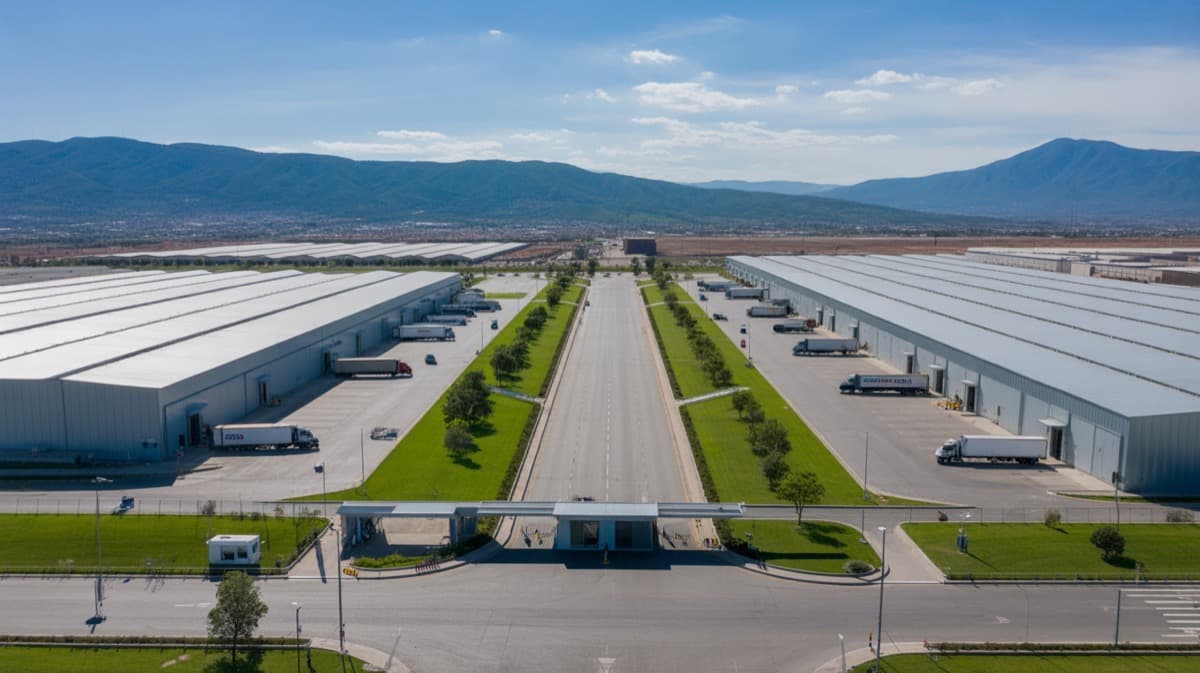
Choosing the right industrial park is one of the most important decisions you will make before building your facility. The wrong park can cost more than the land itself through infrastructure overruns, operational limitations, and problems discovered only after the agreement has been signed.
This guide explains the six critical factors you should evaluate before committing to an industrial park in Querétaro or the Bajío.
1. Electrical infrastructure: do not rely on a promise
This is the factor that creates the most problems when it is not reviewed thoroughly. It is not enough for a park to tell you that "there is sufficient electrical capacity." You need to know the exact number of kVA available for your lot.
Advertised capacity without documentary support can leave the buyer responsible for connection work, upgrades, and delays that were not included in the budget. Feasibility must be confirmed for the specific load and lot.
What you should request before signing:
- Actual electrical capacity available in kVA for your specific lot.
- Voltage level, connection point, and work required to receive service.
- Distance from the nearest substation to your property.
- Whether backup or redundant electrical infrastructure exists.
- Connection costs and whether they are included in the price of the land.
The utilization voltage of the machinery does not by itself demonstrate that the lot has available capacity. Distance, transformation, protection, power quality, and connection work must be defined before contracting.
2. Water supply: an increasingly critical issue
Water is under pressure in Querétaro. Its availability cannot be taken for granted, especially in new developments or areas experiencing rapid industrial growth.
Questions you should ask:
- Supply source: Where does the water come from? The park's own well, the municipal network, or tanker trucks?
- Guaranteed volume: How many cubic meters per day are allocated to your lot?
- Treatment plant: Does the park have a wastewater treatment plant? Does it have available capacity for your operation?
- Water quality: If your process requires treated or demineralized water, can the park's infrastructure support it?
If the park cannot receive the operation's discharge, the project will need to address treatment, conveyance, and authorization through another route. The scope and cost depend on flow, contaminants, the discharge point, and the competent authority.
3. Site conditions: what you cannot see can cost millions
The land is literally the foundation of your project. A soil mechanics study before purchase is not an expense; it is the investment that can save you the most money over the entire project.
What the study reveals:
- Geotechnical behavior: The study provides parameters for the designer to define foundations, allowable settlement, and platform preparation. It does not support assigning a generic cost overrun without first designing the solution.
- Groundwater level: If groundwater is shallow, excavation and foundation work become significantly more complex.
- Subsoil composition: Expansive clays, artificial fill, or rock layers can completely change the structural design and budget.
In the El Marqués and Colón areas of Querétaro, soil conditions vary greatly among parks located only a few kilometers apart. Do not assume that your site has good soil simply because a neighboring park does.
4. Connectivity and access: think about daily operations
An industrial park can have perfect infrastructure, but if your tractor-trailers cannot enter or leave easily, your logistics operation becomes a permanent problem.
Evaluate the following:
- Heavy-vehicle access: Can double-trailer combinations enter? Are the turning radii on internal roads sufficient?
- Distance to main roads: How many kilometers separate the site from the nearest highway or federal road? Every additional kilometer traveled translates into daily logistics costs.
- Time restrictions: Some municipalities restrict heavy-vehicle traffic during certain hours. Verify that these rules will not affect your operation.
- Public transportation: If your facility will employ people who depend on public transportation, the park's accessibility becomes a talent-retention factor.
In Querétaro, parks located along the Federal Highway 57 corridor (San José Iturbide, Pedro Escobedo) offer direct connectivity to the national highway network, while others in more remote areas may require investment in dedicated access.
5. Internal regulations: rules no one reads until it is too late
Every industrial park has its own rules. Some of those rules can constrain your project in ways you may not anticipate.
Provisions you should review include:
- Maximum building height: If your operation needs 14 meters of clear height and the park limits buildings to 12 meters, you have a problem.
- Facade type: Some parks require specific facade finishes—such as exposed masonry or quarry-stone cladding—that increase cost.
- Permitted industrial activities: Not every park accepts every business activity. Chemical processes, foundries, or hazardous-waste handling may be restricted.
- Buildable-area percentage: The park's COS (site coverage ratio) defines how much of your land can be covered by construction. A COS of 0.70 means you can cover only 70% of the site.
- Required green areas: Some regulations require a minimum percentage of landscaped area, reducing your buildable area.
Request the complete regulations before signing the purchase agreement, not afterward. Any restriction discovered late becomes an expensive redesign.
6. Hidden costs: the true price is more than the price per m²
The price per square meter quoted by an industrial park rarely includes everything. To compare parks fairly, you must add all associated costs.
Common additional costs include:
- Maintenance fee: Request the current rate, calculation basis, included services, adjustment rules, and any special assessments.
- Reserve fund: Some parks charge an initial amount for major maintenance of common areas.
- Utility connections: Water, drainage, electricity, and gas may carry connection costs separate from the land price.
- Security: Is it included in the maintenance fee, or is it an additional cost?
- Waste management: Industrial-waste collection may or may not be included by the park.
Add everything before comparing alternatives. A site with high fees and expensive connections may ultimately cost more than one with a slightly higher price per m² that already includes those items.
Checklist: what to request before signing
Summarize your evaluation using this list of documents and data you should request from any industrial park before making a decision:
- Available electrical capacity in kVA (technical document, not a marketing brochure)
- Water-supply certificate and guaranteed volume
- Soil mechanics study for the specific lot—or permission to conduct one
- Road plan with load specifications
- Complete internal park regulations
- Breakdown of maintenance fees and connection costs
- Applicable land-use authorization and municipal licenses
- Information on companies already established in the park (park references)
A good industrial park does more than sell you land. It provides the infrastructure, services, and conditions your operation needs to function from day one. Choosing with complete information makes the difference between a project that starts smoothly and one that begins with preventable problems.
Are you evaluating a site at Industrialix? We can discuss the construction scope for a new facility within the park. Grupo COB works as an independent contractor and does not sell land, represent the park or guarantee its approvals.
Ready to start your project?
Contact us for a personalized quote. Our team of experts is ready to help.
Request a QuoteRelated Articles
How to Choose the Right Industrial Contractor for Your Project
Criteria for choosing an industrial contractor in Mexico: experience, team, BIM, financial capacity, contract, safety, and warranties.
Permits Required to Build an Industrial Facility in Querétaro
Permitting path for an industrial facility in Querétaro: land use, municipal license, professionals, environmental review, civil protection and utilities.
How Much Does an Industrial Facility Cost in Querétaro?
How to prepare and compare the cost of an industrial facility in Querétaro using equivalent scopes, designs, quotations, inclusions, and exclusions.