

Testing building systems before an industrial facility opens
Updated
Original Spanish article: November 16, 2026.
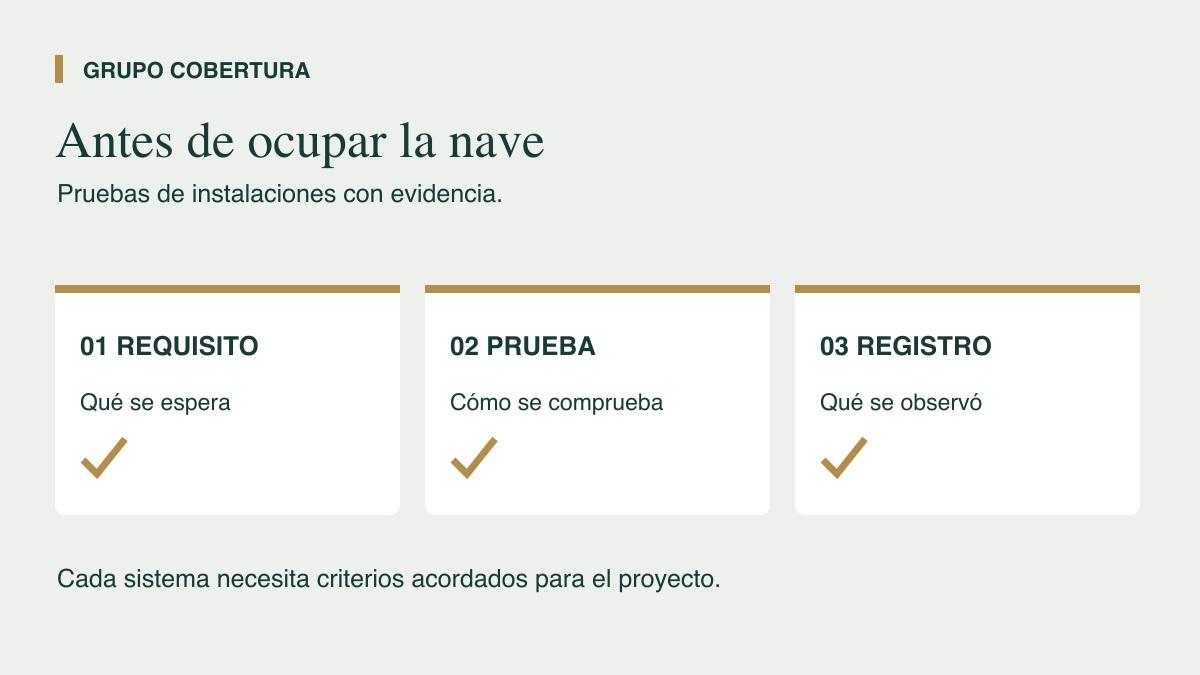
The move-in date is on the calendar. Equipment is in place, and the site walk leaves few visible items to finish. Before occupying the building, the team still needs to verify how its systems perform under the conditions agreed for the project.
This work can be organized through a commissioning process. WBDG connects commissioning with the owner's requirements and documented verification of system performance [1]. Its scope is defined for each building; switching everything on once does not establish that scope.
Agree on the result to be accepted
Before scheduling a test, collect the requirements the system must meet. The responsible team needs to know which function it will verify, under which conditions and against which document. A request that everything should work well leaves too much room for interpretation.
A test sheet can identify the system, requirement, approved procedure, expected result and person accepting the evidence. Project specialists must define the values and actions. This article offers a way to organize the review, rather than a technical testing procedure.
Assign responsibilities
WBDG describes commissioning as a team effort involving the owner and professionals with capabilities suited to the project [2]. Agree on who leads the review, who performs the tests and who can resolve findings.
Include operations when the result affects daily work. A signal may appear correctly on a panel, while the shift supervisor still needs to recognize it and know whom to contact. That discussion helps prepare the training that will accompany handover.
Record the actual conditions
For each test, identify the equipment, date, participants and operating conditions. Attach the reports or measurements required by the approved procedure. If a necessary condition is unavailable, record the limitation and agree on how verification will be completed.
Commissioning documentation connects project requirements, decisions and results [3]. A photograph of operating equipment may belong in the record, but it does not describe every function that needs verification.
Follow findings through to verification
Keep an issues list with a precise description, an assigned owner and an agreed response date. When a correction is made, record how its outcome will be checked. An update saying that work has been done should lead to the required verification.
For example, a test may produce a signal different from the expected one. The record should let the team follow that observation from discovery through the subsequent check. It will help building operators even after the construction team has left.
Hand over the knowledge as well
Coordinate accepted reports, manuals and training with building handover. Make clear which tests have been accepted and which require a later condition. Permits and requirements applicable in Mexico must be reviewed separately with the project professionals.
Grupo Cobertura can help you review how these activities fit into an industrial building programme. Defining them during design helps reserve time, assign responsibilities and prepare records before occupancy.
Sources
Ready to start your project?
Contact us for a personalized quote. Our team of experts is ready to help.
Request a QuoteRelated Articles
Technical Handover of an Industrial Building
What to review before accepting an industrial building: acceptance criteria, functional testing, outstanding items, as-built drawings, manuals, and training.
Electrical Systems for Industrial Buildings
How to plan an industrial building's electrical system: demand, substations, panels, raceways, grounding, backup power, safety, and future growth.
Wind on Industrial Buildings: Roofs, Doors and Fasteners
Why wind lifts an industrial building's roof, what happens when a large door stays open, and what to check at corners, edges and rooftop equipment.