
Fire Protection Systems for Industrial Buildings
Updated
Original Spanish article: June 29, 2026.
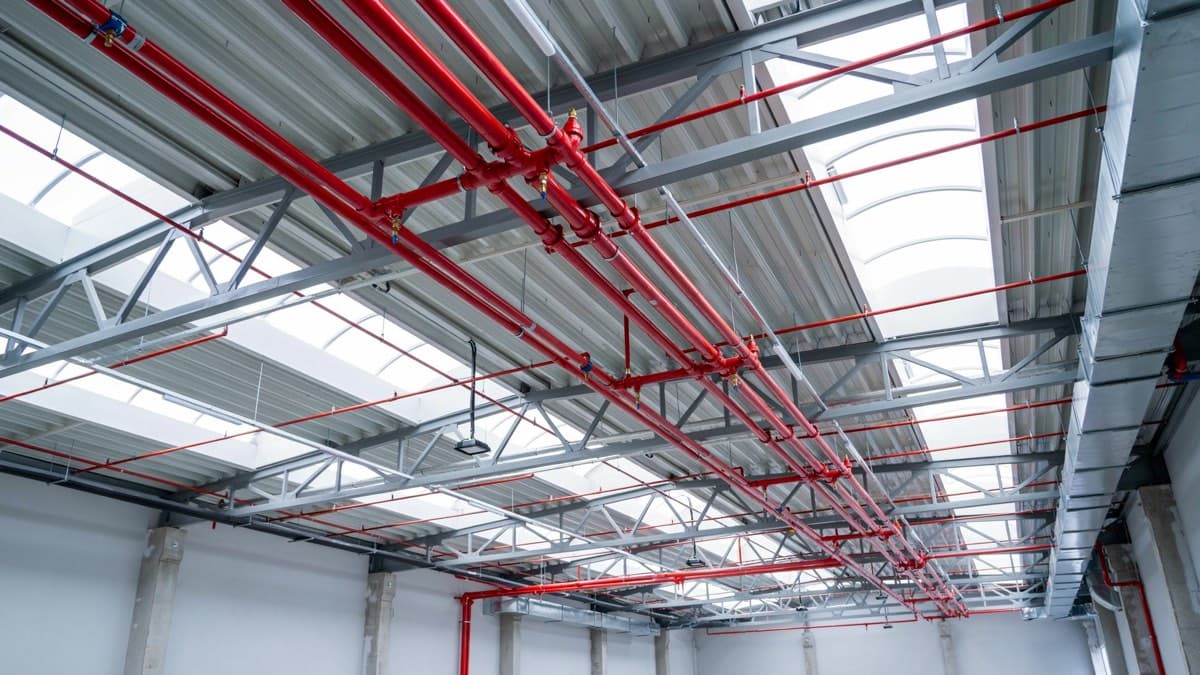
A fire protection system is something you hope you never have to use. At the same time, it can determine whether an industrial building can operate, whether it can be insured, and, in the worst case, whether you lose only inventory or the entire building. That is why it is not an add-on: it is part of the design from the beginning.
This guide explains, without unnecessary jargon, how fire protection for an industrial building is conceived and why the insurer, rather than the law, often ends up setting the standard.
Why fire protection is designed from the beginning
Fire protection is not simply a matter of adding a few sprinklers at the end of construction. It requires reserving space for a water tank, planning for a pump, sizing pipes that cross the building, and, above all, designing everything around what will be stored and at what height. Solving it after the building has been constructed is much more expensive and almost never turns out as well as when it is planned from the start.
The underlying principle is that the system must be designed for the building's actual risk. Protecting a warehouse with low-flammability products stored at a low height is not the same as protecting one with combustible materials stored in high racks.
Sprinklers: the foundation of the system
Automatic sprinklers are at the heart of almost every fire protection system in an industrial building. They operate automatically: each sprinkler is activated by heat directly in the area where the fire begins, without anyone having to trigger it. They do not "all activate at once" as they do in movies; only those located over the fire open.
The most common arrangement in the Bajío climate is a wet-pipe system, with the piping always filled with water and ready to discharge. Dry-pipe systems also exist, in which the piping contains air and water enters only after activation, but they are reserved for areas at risk of freezing, which is uncommon here.
ESFR: sprinklers designed for high-piled storage
When an industrial building uses high-rack storage, ordinary ceiling sprinklers may not be enough because the fire grows while shielded among the stored goods before the water reaches it. That is why ESFR systems exist. The acronym stands for Early Suppression Fast Response.
These are fast-response, high-discharge sprinklers installed at the roof, designed not only to control a fire but to suppress it. Their main practical advantage is that, in many cases, they eliminate the need to install sprinklers inside the racks, simplifying warehouse operations. In return, they require specific roof-height, storage-height, and water-pressure conditions, so they are not a universal solution: they apply when the project meets their requirements.
It is not only sprinklers: the complete network
A fire protection system includes more than the sprinkler heads visible at the ceiling. A complete installation in an industrial building usually includes:
- Water storage: a tank dedicated exclusively to the fire protection system, sized to sustain the discharge for the time required by the design.
- Fire pump: the equipment that provides the necessary pressure and flow, normally accompanied by a smaller pump that maintains network pressure (a jockey pump).
- Hydrant and hose network: for manual firefighting where required.
- Detection and alarm: detectors and an alarm system that provide timely warning and support evacuation.
- Fire extinguishers and signage: distributed according to the risk, with clearly marked evacuation routes and exits.
Every component is sized as part of the whole. Excellent sprinklers are of little use if the water tank or pump cannot sustain the required discharge for the necessary duration.
Who sets the standard: regulations and insurance
Mexico does not have a single standard requiring sprinklers in every industrial building. On the regulatory side, the main applicable standard is NOM-002-STPS, which covers workplace safety conditions and fire prevention and protection, in addition to state and municipal civil protection requirements. These form part of the procedures detailed in our guide to permits and procedures for building an industrial facility in Querétaro.
In practice, however, the most demanding standard is often set by the insurer. To insure the building and its contents, many insurers require a system designed to recognized international standards such as those issued by the NFPA—particularly NFPA 13 for sprinkler system installation. It is very common for insurance requirements, rather than the law, to determine the level of protection ultimately installed in the building.
What changes the design
The system is designed according to risk, not square footage. The factors with the greatest effect on the design are:
- What is stored: the type of goods and their degree of flammability change everything.
- How high it is stored: high-rack storage is what most often drives the design toward ESFR-type solutions.
- The building height: this determines which systems are feasible.
- What the insurer requires: this is often the strictest requirement of all.
Common mistakes
- Leaving fire protection until the end. Without space for a water tank and without a planned network, the solution becomes expensive and forced.
- Designing without knowing what will be stored. Risk defines the system; a change of use can leave the building underprotected.
- Forgetting the insurer. A building that meets the official minimum but not the insurer's requirements may be left without coverage.
- Focusing on sprinklers while neglecting water storage. Without a properly sized tank and pump, the system cannot sustain the discharge.
What is worth remembering
Fire protection is the system you hope never to use, which is precisely why it is worth designing correctly once, from the beginning.
Three ideas to remember:
- Sprinklers are the foundation, and ESFR systems exist for high-piled storage. When their conditions are met, they may eliminate the need for in-rack sprinklers.
- The system is a complete network: sprinklers, a dedicated water tank, a pump, detection, and alarms—not only the heads at the ceiling.
- In Mexico, the insurer often sets the effective standard, with reference to NFPA, beyond the minimum required by official regulations.
If you are planning fire protection for a project, it should be reviewed together with industrial roofs and roofing systems, where much of the overhead installation is resolved, and its effect on the construction budget should also be considered.
Fire protection needs to be coordinated with the building’s overall scope. Share your project with Grupo COB to define engineering coordination and the involvement of the relevant specialists, authorities and insurer.
Ready to start your project?
Contact us for a personalized quote. Our team of experts is ready to help.
Request a QuoteRelated Articles
Industrial Roofs: Systems, Seals, and Insulation
How to define roofing sheets, insulated panels, slopes, stormwater drainage, laps, skylights, and maintenance for a reliable industrial roof.
LEED for Industrial Buildings: Scope and Decisions
What LEED certification means for an industrial building, and which energy, water, materials, site and operating decisions must start in design.
Truck Courts for Industrial Buildings
Key considerations for designing industrial truck courts: design vehicle, access, turning radii, docks, staging, pavement, drainage, and pedestrian safety.